
How Exceptional Communication Can Transform Client Expectations
A Funny Thing Happened on the Way to the Conference…I stepped out of my house, loaded up my Avalanche and prepared to head off toward Houston. Tektonic 2026 was upon me, and I was excited. I woud be podcasting, presenting a session and participating in a coaches panel. It was shaping up to be one of those great industry experiences where you get to do what you love with people who love this business too.
I fired up the truck and was immediately greeted with a low-tire warning. No big deal, right? Add some air and boogie on down the road.
Not so fast.
I got out, walked around, and sure enough, the tire was completely flat. Well, at least completely flat on the bottom. That is how these things work, isn’t it? The timing is never convenient. The problem never checks your calendar to say, “Looks like Vic has a conference, a presentation and a tight schedule. Maybe I’ll wait until next week.”
Nope. It shows up when it wants.
So, I made the mental shift. There was no use getting mad; no use staring at the tire like that was going to fix it. I headed over to a national tire chain, thinking I would get the flat repaired and be back on the road in no time.
That was wishful thinking.
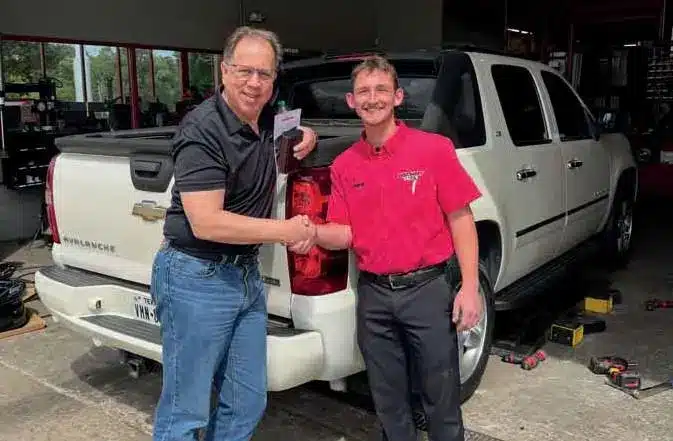
The young man at the counter, Jimmie, greeted me with a smile and got things moving. A little while later, he asked me to step outside so he could show me something. That is almost never the beginning of a conversation you want to hear.

He walked me to the rear tires and showed me the issue. They were not worn out, but they were badly cracked and close to delaminating. In other words, I had come in for a flat, but the real problem was bigger than my expectations.
Now, time was not on my side – I had places to be. But I looked at the tires, took a deep breath and approved the rear tires. Then Jimmie made me a deal on all four, which of course meant a bigger repair, a bigger ticket and a bigger interruption to my day than I had planned.
I let him know, very clearly, that time was more precious than money.
He looked me in the eye and said, “Rest assured, we’ll get you out as quickly as possible.”
And you know what? He did.
As I recently thought about the whole experience, it hit me: every day, this same scenario plays out across the country in shops just like yours. A customer comes in with what they think is one problem, then your team discovers what is actually going on. That’s when the real work begins. Not just the repair work: the people work; the communication work; the trust-building work.
Some service providers handle that moment beautifully. Others fail spectacularly.
What happened to me on the way to Houston is a perfect reminder of what your clients need from you every single day. Here are five surefire ways to take care of your clients as well as Jimmie took care of me.
Solve the Problem They Came In With, But Don’t Stop There
My immediate concern was a flat-tire warning. That was the pain I could feel but the actual need was deeper. Had they simply patched one issue, aired up the tire and sent me down the highway without addressing the cracking and risk of delamination, they would have solved the symptom while ignoring the real danger.

Your clients do this every day. They come in saying, “It just needs an oil change,” or “I think I need brakes” or “Can you check a noise?” That is the starting point, not the finish line.
A great shop understands that the customer’s concern which opens the door, but a complete inspection tells the real story.
This is where your technical specialist shines; their job is not just to confirm the obvious. Their job is to thoroughly go over the vehicle and identify what the client needs to stay safe, reliable and confident on the road. Then your service advisor steps in and translates that technical detail into clear, understandable value.
Do not just fix the flat; do not just handle the symptom. Determine if there is a bigger issue and professionally present it.
That is how you protect the client, how you earn trust and how you serve with excellence.
Show, Don’t Just Tell
One of the smartest things Jimmie did was ask me to come outside.
He did not stand behind the counter and say, “Sir, your tires are bad.” He did not toss around vague language and expect me to take it on faith. He showed me the concern and I saw the cracking with my own eyes. I saw the condition and I saw the risk.
That changed everything.
When clients can see what you see, the conversation changes from suspicion to understanding.
This is one of the reasons digital inspections are so powerful when they are done well. Photos, video, measurements and clear notes give your client the ability to understand the vehicle condition instead of feeling like they are being sold something in the dark.
People do not resist value nearly as much as they resist uncertainty.
When your team clearly, calmly and professionally shows the issue, you reduce fear and increase confidence. You are no longer just recommending work – you are helping the client make an informed decision.
And let me say this clearly, if your service advisor has to “sell” too hard, there is a good chance that the inspection and presentation did not do enough of the heavy lifting. Show first, and then explain.
Respect the Customer’s Priorities, Not Just Your Process
I told Jimmie something important when I said time was more precious than money. He did not ignore it, he did not just nod politely and then move me into some generic workflow. He listened and understood what mattered most to me in that moment, and he responded accordingly.
Every client has a priority. Some are price-sensitive, some are time-sensitive. Some are anxious because they have had a bad experience elsewhere. Some are worried because they know just enough about cars to be nervous and not enough to feel confident.
Your job is to find out what matters most to them.
That means asking better questions, and it means listening for what is underneath the words. It means not treating every customer interaction like it came off an assembly line.
You may have an efficient process and, of course, that matters. But clients do not judge you by process charts and workflow boards. They judge you by whether they feel heard, understood and cared for.
Respecting priorities does not mean becoming chaotic. It means being human by making your systems serve the customer, rather than making the customer serve your systems.
That is where real hospitality begins.
Communicate With Confidence and Calm
When a customer hears that a simple problem just turned into a more expensive one, emotions can rise quickly. Frustration, doubt, suspicion and stress all show up at once. That is why tone matters.
Jimmie never came across as pushy, flustered or defensive. He was calm, clear and confident. He gave me the information to understand the urgency, offered a solution and reassured me that they would move as quickly as possible.
That kind of communication creates confidence – and it’s where so many shops either win big or lose badly. If your advisor sounds uncertain, rushed or overly aggressive, the client feels it. If your technical specialist writes notes that are vague or incomplete, the advisor has a harder time communicating value. If no one owns the conversation, the client starts filling in the blanks and they usually do not fill them in your favor.
Confidence does not mean pressure; calm does not mean weak. The best communicators in our industry know how to be direct, warm and professional all at the same time.
Your clients are borrowing confidence from you. If you sound like you know exactly what is happening and exactly what should happen next, they can exhale a little. That is a gift.
Deliver On the Promise
This may be the biggest one of all: Jimmie told me they would get me out as quickly as possible, and they did.
That is where credibility is built: it’s not in the estimate or the lobby. It’s not in the first smile. Yes, those things matter, but the true test is whether the experience matches the promise.
In our business, overpromising and underdelivering is poison.
Don’t tell a client 2 p.m. if you know it is probably 4 p.m. Don’t say, “No problem,” when it is in fact a very big problem. Don’t speak in absolutes just to make the moment easier; easy now becomes painful later.
When you set expectations honestly and then meet or exceed them, you create loyalty.
Think about how many clients would gladly pay a little more to work with a shop that is honest, communicative, organized, and dependable. They are not just buying a repair, they are buying peace of mind.
That is what I got on that day, and that is what your clients want from you.
By the time I got back on the road toward Houston, I was not thinking about the inconvenience nearly as much as I was thinking about the lesson. A flat tire, a time crunch, a change of plans and one capable young man who handled the moment well turned into a real reminder of what great service looks like: It’s not magic or complicated – it’s intentional.
Solve the real problem; show the client what you found. Then respect what matters to them. Communicate with confidence and deliver on what you promise.
Do those five things consistently, and you won’t just fix cars; you will build trust, create loyalty, and stand out from the crowd.
And one final thought, the person who took such good care of me today was Gen Z. Jimmie did not fit the tired stereotypes people like to throw around. He was sharp, respectful, attentive, professional, and he listened, he communicated, and he delivered. That should be encouraging to every shop owner reading this. The future of our industry will depend on the next generation, and today I got to see a great example of what can happen when an organization implements a strong training program. A person is given the chance to step up and do the job right. A funny thing happened on the way to the conference. I did not just get four new tires. I got a fresh reminder that the future of service is already showing up for work.
And if your team can make your customers say, “They took great care of me,” then you are doing more than automotive service. You’re doing business the right way.
Vic owned and operated a successful shop in The Woodlands, TX, for over three decades. If this article struck a chord, take a few minutes to slow down before moving on to the next task. Email [email protected] or visit www.ShopOwnerCoach.com for your free” More Than a Repair: Five Ways to Win the Customer Experience” worksheet or to book your complimentary coaching session or learn more about 20 Groups, or coaching programs.
Ready to grow? Join a Shop Owner Coach 20 Group and surround yourself with peers who help you reach new heights. Connect directly with Vic Tarasik, founder of Shop Owner Coach, helping independent shop owners achieve their dreams through proven business practices.